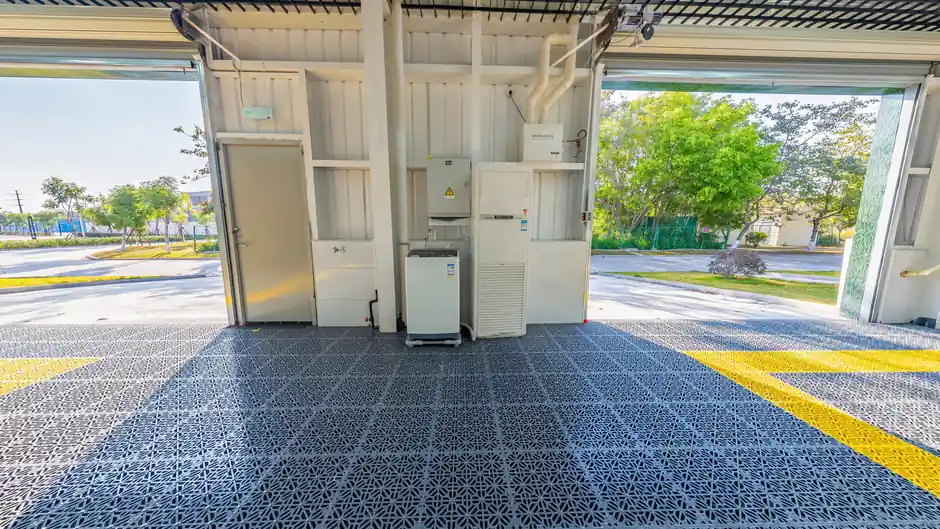
Anti-slip epoxy flooring for Richmond garages and workshops is a resin floor coating with a mineral grit broadcast into the wet topcoat, giving a textured surface that stays grippy when wet. It solves the specific problem of smooth concrete turning slick under tire drip, rain, and Lulu Island humidity. This post covers why local slabs get slippery, how grit systems work, what installation costs in 2026, and the mistakes that ruin a DIY anti-slip job.
Why Richmond garages and workshops get slippery
Richmond's winter brings 1,100 mm of rain between October and March, and every car that parks in your garage drags that water in on its tires and undercarriage. Bare concrete absorbs some of it, but a sealed or painted slab holds a film of water on the surface. That film is what sends you sliding when you step out of the driver's seat in rubber-soled shoes.
Workshops have a second problem: sawdust, metal shavings, and oil mist settle on the floor and mix with condensation to create a paste that's worse than plain water. In Steveston and along the Fraser River, the morning dew point sits close to the air temperature for weeks at a time, so a shop floor that looks dry at 7 a.m. can be damp by 9 a.m.
Older Richmond homes and industrial units often have slabs poured before 1990 with a smooth power-troweled finish. That finish is excellent for moving pallets and rolling tool chests, but it has almost no slip resistance once wet. We see this constantly in the older warehouse conversions around Bridgeport and Shellmont.
How anti-slip epoxy flooring works
Anti-slip epoxy flooring is a floor coating system that uses a broadcast aggregate to create a high-friction surface, typically rated between 0.60 and 0.80 on the coefficient of friction scale. The epoxy base bonds to prepared concrete, and while the final coat is still wet we broadcast aluminum oxide, quartz, or silica grit across the entire surface. The grit sinks partially into the resin and locks in place.
Once cured, the grit particles sit proud of the resin by roughly 0.2 to 0.5 mm. That's enough texture to bite into a boot sole without being so rough that you can't sweep or mop it. A properly done anti-slip floor still rolls a floor jack smoothly and doesn't shred cardboard boxes dragged across it.
The slip resistance comes from two things: the mechanical grip of the grit, and the fact that epoxy is waterproof. Water beads on top instead of soaking in, so the surface drains and dries faster than bare concrete. That matters in a Richmond garage where a wet car parks every night.
If your existing slab has cracks or spalling, we handle that first with concrete crack repair Richmond before any coating goes down. Skipping that step is the fastest way to watch a new floor fail within a year.
Grit options: aluminum oxide, quartz, and silica compared
Aluminum oxide is the grit we recommend for most Richmond garages and workshops because it's the hardest of the three and doesn't break down under foot traffic. It's also the most expensive, adding roughly $0.50 to $1.00 per square foot to the job.
Quartz is the middle option. It's slightly softer than aluminum oxide but bonds beautifully with epoxy and gives a more uniform look. Many of our flake epoxy flooring Richmond installations use quartz as the anti-slip layer under the decorative flakes.
Silica sand is the budget choice. It works, but it wears down faster in high-traffic lanes and can polish smooth over five to seven years. We generally only use silica in low-traffic storage areas or on rental properties where budget is the deciding factor.
Here's how the three compare on the numbers that matter:
- Aluminum oxide: Mohs hardness 9, lifespan 10-15 years in a garage, adds $0.50-$1.00/sq ft
- Quartz: Mohs hardness 7, lifespan 8-12 years, adds $0.35-$0.75/sq ft
- Silica: Mohs hardness 6-7, lifespan 5-7 years, adds $0.20-$0.40/sq ft
Grit size matters too. A 60-grit aggregate gives an aggressive texture that's ideal for a workshop where oil and coolant spill. A 100-grit aggregate is finer and easier to clean, which suits a residential garage that doubles as a gym or storage area.
What does anti-slip epoxy flooring cost in Richmond in 2026?
Typical 2026 pricing for anti-slip epoxy flooring in Richmond runs $4.50 to $8.00 per square foot installed, depending on slab condition, grit type, and whether we need to grind or repair the concrete first. A standard 400 sq ft double garage lands between $1,800 and $3,200.
Workshop floors cost more because they usually need a heavier build. A 1,000 sq ft shop with chemical-resistant topcoat and aluminum oxide grit runs $5,500 to $9,000. If the slab has significant oil contamination, add $0.75 to $1.50 per square foot for extra grinding and priming.
For comparison, a plain epoxy garage floor without anti-slip grit costs $3.50 to $6.00 per square foot. The grit itself is a small part of the total - most of the difference comes from the extra topcoat and the labor to broadcast evenly.
We quote every job after seeing the slab. A 20-year-old Richmond garage with hairline cracks and a failing sealer is a different job than a new pour in a townhouse complex, and pricing should reflect that.
Installation steps for a garage or workshop floor
A proper anti-slip installation takes two to three days from start to foot traffic, with a full cure of five to seven days before you park a car on it. Here's the sequence we follow.
- Diamond grinding. We grind the entire slab with a 30-grit diamond tool to open the concrete profile. This removes old sealer, tire marks, and surface contamination.
- Crack and spall repair. We fill cracks with a semi-rigid epoxy patch and feather any spalled areas. This is where concrete floor preparation Richmond makes or breaks the job.
- Primer coat. A penetrating epoxy primer goes down at 200-300 sq ft per gallon, depending on slab porosity.
- Base coat. We roll the colored epoxy base at 8-12 mils wet film thickness and let it cure overnight.
- Grit broadcast. While the topcoat is still wet, we broadcast aluminum oxide or quartz at roughly 0.5 lb per 100 sq ft. The grit must go on within the recoat window - usually 15 to 30 minutes.
- Clear topcoat. Once the grit layer cures, we apply a clear epoxy topcoat Richmond to lock the grit in and seal the surface.
- Cure and inspection. We walk the floor with you at 48 hours and again at day seven to check for any thin spots or grit clusters.
Temperature matters. Epoxy needs slab and air temperatures above 10°C to cure properly. In a Richmond winter, we often run heaters in the garage overnight to hold that temperature.
Common mistakes we see on DIY anti-slip jobs
The most common mistake is broadcasting grit too late, after the epoxy has started to skin over. The grit sits on top instead of sinking in, and it sweeps off within weeks. You end up with a floor that's slightly rougher than before but no real slip resistance.
The second mistake is using too much grit. More isn't better. Over-broadcasting creates a surface that traps dirt, tears mop heads, and feels like sandpaper underfoot. We aim for a uniform single-layer broadcast, not a thick crust.
Third, skipping the clear topcoat. Without it, the grit is only mechanically held by the base resin and starts to release under traffic. The topcoat is what makes the system last.
Fourth, coating over a damp or contaminated slab. Richmond's high water table means some garage slabs wick moisture from below. If you coat over that without a moisture test, the epoxy blisters within months. We always run a calcium chloride test or plastic sheet test before quoting.
Finally, forgetting the expansion joints. If you fill them solid with epoxy, the slab will crack elsewhere when it moves. We fill joints with a flexible polyurethane sealant instead.
When to call a professional
If your garage floor has more than three or four visible cracks, or any area where the concrete crumbles under a screwdriver, the slab needs repair before coating. That's beyond a weekend DIY project. We handle the grinding, patching, and coating in one visit so you're not juggling three contractors.
If you've already tried a DIY anti-slip kit and the grit is coming off, we can often fix it without a full removal. We grind back the failed topcoat, re-broadcast, and re-seal. That's usually 40% cheaper than starting over.
And if your workshop handles solvents, hydraulic fluid, or food products, you need a coating system rated for those chemicals. Standard epoxy won't hold up to repeated solvent exposure. We spec chemical-resistant epoxy flooring Richmond for those spaces.
Richmond Elite Epoxy Flooring installs anti-slip systems across Richmond, from Steveston garages to Bridgeport workshops. We test the slab, quote the job, and stand behind the install.
Frequently asked questions
How long does anti-slip epoxy flooring last in a Richmond garage?
With aluminum oxide grit and a clear topcoat, expect 10 to 15 years in a residential garage and 7 to 10 years in a busy workshop. Longevity depends on traffic, grit type, and whether you keep the floor clean of abrasive grit and gravel.
Can I add anti-slip grit to an existing epoxy floor?
Yes, if the existing coating is well-bonded. We scuff the surface, apply a fresh epoxy topcoat, broadcast grit, then seal with a clear coat. If the old coating is peeling or flaking, it needs to come off first.
Is anti-slip epoxy hard to clean?
Not if the grit is applied correctly. A medium 80- to 100-grit texture sweeps and mops like a normal floor. Overly aggressive grit or too much grit is what makes cleaning difficult. We match the grit size to how you use the space.
Does anti-slip epoxy work on a wet garage floor?
It works best on a dry slab. If your garage floor stays damp from groundwater, we install a moisture-mitigating primer first. Coating over a wet slab without that step causes blistering and peeling within the first year.
How soon can I park on anti-slip epoxy flooring?
Foot traffic after 24 hours, light vehicle traffic after 72 hours, and normal parking after 7 days. Cooler Richmond weather extends those times. We give you a written cure schedule when we finish the job.
Get help with Epoxy Flooring in Richmond
If your garage or workshop floor turns slick every time it rains, we can fix that with a properly broadcast anti-slip system. Call Richmond Elite Epoxy Flooring at +7742316666 and we'll schedule a slab assessment this week.