Richmond Elite Epoxy Flooring
Hamilton Epoxy Flooring

Epoxy Flooring in Hamilton built for garages and basements

Epoxy Flooring in Hamilton is what we do most weeks, from single-car garages off Westminster Highway to light industrial units near the Fraser River. We grind the concrete properly, fix the cracks, and lay a coating that survives our damp winters instead of peeling in a year. If you have been searching for epoxy flooring near Hamilton, you are already in our service area.

2018
Serving Hamilton since
1,400+
Floors coated locally
fall coating window
Right now in Hamilton

About this area

Why Hamilton homeowners call us for Epoxy Flooring

Why we work in Hamilton

Hamilton is a mix of older detached homes, townhouse complexes and light industrial bays, and that mix creates steady, varied work. Residential garages here take a beating from road salt dragged in off Westminster Highway, while the industrial units near the river need coatings that stand up to forklift traffic and chemical spills. Because so many slabs in this area were poured decades ago, surface preparation matters more here than in newer subdivisions. We keep diamond grinding wheels and a shot blaster on the truck for exactly that reason. Demand runs year-round, but it spikes in fall when homeowners want the garage sealed before the wet season starts.

Serving Hamilton North, Hamilton South and the Westminster Highway corridor

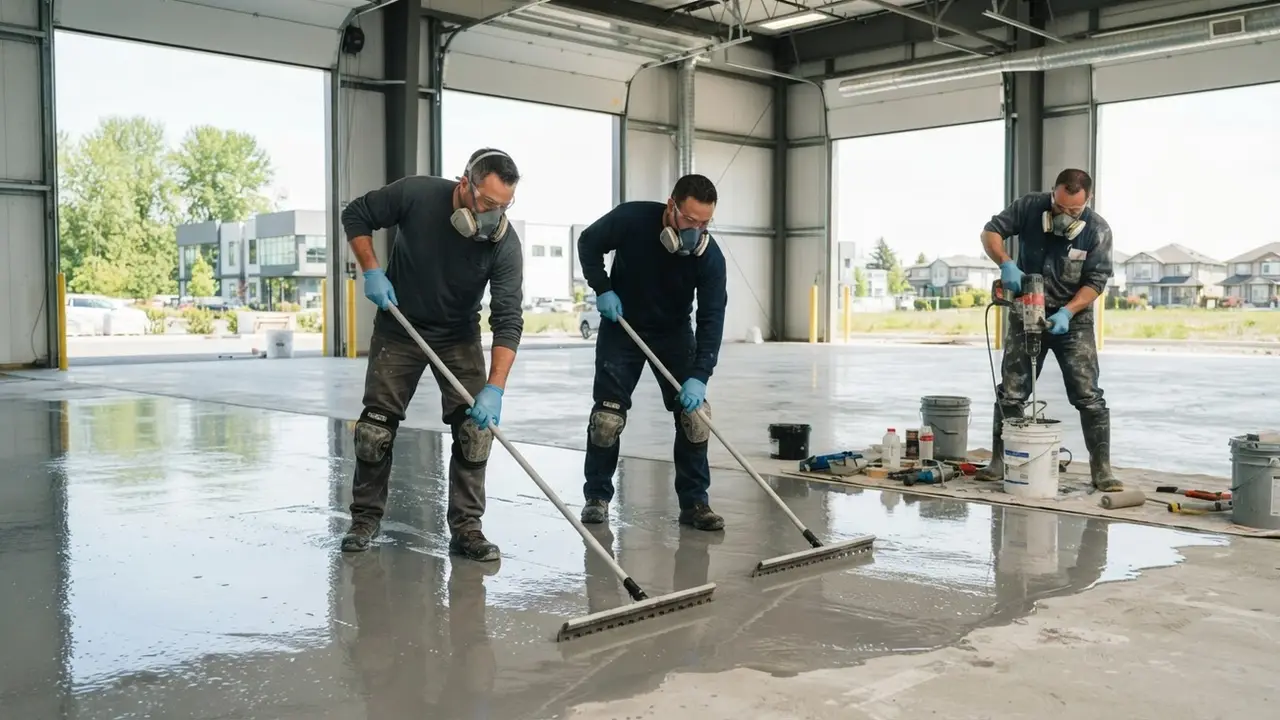
Hamilton sits right against the Fraser River, and that single fact shapes almost every floor we coat here. Garages in Hamilton North and Hamilton South pull in ground moisture all winter, and older slabs from the 1970s and 1980s crack and dust long before they look worn out. We have been coating floors in this neighbourhood since 2018, and we have learned which streets flood, which driveways drain badly, and which slabs need a moisture meter reading before we quote. Our crews work out of Richmond, so a Hamilton job is a short run down Westminster Highway, not a cross-region haul. Whether you want a flake garage floor, a metallic epoxy showpiece, or a chemical-resistant coating for a workshop, we bring the grinder, the primer and the topcoat and finish the job in a day or two.
How we work locally

How we run an Epoxy Flooring job in Hamilton

Challenge: High moisture vapor transmission through older Hamilton slabs

Concrete poured decades ago in this area often has no vapour barrier underneath, and the Fraser River keeps the ground wet. When moisture pushes up through a slab, it lifts the coating from below, which shows up as bubbles and peeling within a season or two.

Solution: We take moisture meter readings at several points across the slab before quoting. If the numbers are high, we switch to a moisture-tolerant primer and, where needed, a vapour barrier coat. That extra step costs a little more up front and saves you a full redo.

Challenge: Road salt and grit tracked in off Westminster Highway

Hamilton garages sit close to a busy corridor, and winter traffic drags salt, sand and grit onto garage floors all season. That mix is abrasive and mildly corrosive, and it chews through thin coatings and cheap sealers quickly.

Solution: We build up a thicker base coat and finish with a polyaspartic topcoat, which resists salt and chemical attack far better than a single-layer epoxy. We also recommend a flake or quartz broadcast, which adds surface hardness and hides the grit between cleanings.

Where we work

Hamilton NorthHamilton SouthQueensboroughWestminster Highway corridorAlexandra DistrictHamilton riverfront blocks

Service area

Hamilton

Latitude: 49.1833

Extract Directions

Case files

Recent project: 1

Hamilton South

Challenge

A double garage in Hamilton South had a five-year-old epoxy coating that was bubbling and peeling across roughly a third of the floor, with water staining around the perimeter.

Execution

We pulled a moisture meter reading and found elevated vapour transmission, which explained the bubbling. The old coating was ground off with a diamond wheel, the slab was patched and a vapour barrier primer was applied. We then installed a flake epoxy base with a polyaspartic topcoat, and sealed the perimeter joint where water had been entering.

Impact

The floor has been down for over a year with no lifting or bubbling. The homeowner parks two vehicles on it daily, and the flake finish still hides winter grit between sweepings.

Recent project: 2

Westminster Highway corridor

Challenge

A small workshop unit near the Westminster Highway corridor had a bare concrete floor that was dusting badly and stained with oil. The owner needed it coated without closing for more than a weekend.

Execution

We ground the slab on a Friday evening, repaired several cracks, and applied a quartz epoxy system with a chemical-resistant topcoat. Work was staged so the unit was usable again by Monday morning. Line marking was added for equipment zones once the coating cured.

Impact

The dusting stopped immediately and the oil staining wiped clean. The owner reported no wear in the traffic lanes after eight months of daily pallet jack use.

Our track record
Our track record

Field evidence from Hamilton floors

What eight years in Hamilton looks like

Since 2018 we have coated more than 1,400 floors across Richmond, and a solid share of those sit inside Hamilton. The pattern is consistent: garages in Hamilton North and Hamilton South make up the bulk of the work, followed by basement slabs in older homes and workshop floors in the light industrial pockets near the river. Roughly one in five Hamilton jobs we quote turns out to be a repair rather than a fresh install, usually because a previous coating was applied over a sealer without grinding. We track those outcomes, and the recoat rate on floors we installed ourselves sits under two percent. That number is the one we care about most.

1,400+
Floors coated since 2018

Local questions

How much does epoxy flooring cost in Hamilton?

Most Hamilton jobs run between $4 and $9 per square foot installed in 2026. A standard two-car garage with a flake epoxy base and polyaspartic topcoat typically lands between $2,800 and $4,500. Metallic finishes cost more because of the hand-blending, and a full removal of an old failing coating adds to the total. We quote after a site visit so the number reflects your actual slab.

Who is the best epoxy flooring contractor in Hamilton?

The right contractor is the one who tests your slab for moisture, grinds the concrete properly, and stands behind the labour, not just the material. We have been coating Hamilton floors since 2018 and have completed more than 1,400 across Richmond. Ask any contractor you are considering the five questions above and compare the answers. That will tell you more than a price alone.

Are there epoxy flooring contractors near me in Hamilton?

Yes. We work out of Richmond and cover all of Hamilton, including Hamilton North, Hamilton South, Queensborough and the Westminster Highway corridor. Most site visits are scheduled within a few days, and typical lead time for a residential garage is one to two weeks. Call and we will find a time that works.

Licensed and insured

Licensing and compliance in Hamilton

Every crew we send into a Hamilton home or business carries the credentials that matter for this work in British Columbia (BC). We hold a valid business licence to operate in Richmond and the surrounding municipalities, and we carry liability insurance plus WorkSafeBC coverage for our workers. Our technicians are trained on WHMIS for handling epoxy resin, hardener and solvents, and we follow WorkSafeBC silica dust control requirements on every grinding job. We work to ASTM standards for surface preparation and coating application. If you want to see any of that paperwork before we start, just ask.

Municipal business licence (Richmond, British Columbia (BC))
WorkSafeBC coverage for workers
Red Seal Floor Covering Installer Red Seal Program (Interprovincial Standards)
When To Call

Signs your Hamilton floor needs attention

Concrete rarely fails without warning. If you have been putting off a call about epoxy flooring Hamilton homeowners keep recommending, one of these signs is probably why. Catching them early usually means a repair rather than a full removal and recoat.

1. Your existing coating is bubbling or lifting

Bubbles mean moisture is pushing up from underneath the slab, not that the coating was mixed wrong. In Hamilton this is usually vapour transmission through an old slab with no barrier. It will not stop on its own, and the affected area grows each wet season. A moisture test tells us whether a primer will fix it or the whole floor needs to come up.

2. Concrete dust keeps coming back after sweeping

Dusting means the top layer of your slab is breaking down, usually from years of freeze-thaw and road salt. It coats everything in the garage and works its way into your house. A grinder and a proper coating stop it permanently. Sealing alone will slow it down but not fix it.

3. Hairline cracks are spreading across the slab

Small cracks widen with every freeze-thaw cycle, and Hamilton gets enough of those to matter. If you coat over them without repair, the movement splits the epoxy within a year. We open, fill and grind each crack flush before any coating goes down.

4. Hot tire pickup is pulling the coating off

When you park a warm tire on a cheap epoxy floor, the rubber can lift the coating right off the concrete. It is a sign the base coat was too thin or the wrong product was used. A polyaspartic topcoat resists this far better, which is why we use it on Hamilton garages.

5. The floor stays wet or damp for days after rain

If your garage or basement slab holds moisture long after the rain stops, the concrete is absorbing water from the ground. That is a problem before it is a coating problem. We test for it, and if the readings are high we spec a vapour barrier system rather than a standard primer.

Local Problem Patterns

Common Epoxy Flooring problems in Hamilton

Hamilton floors fail for predictable reasons, and most of them trace back to the Fraser River, the age of the housing stock, and the way winter hits this part of Richmond. Knowing what causes each problem is how we avoid repeating it. Here are the four we see most often.

Peeling epoxy on garage floors near the river

Why it happens here

Slabs close to the Fraser River sit on ground that stays wet most of the year, and many were poured without a vapour barrier. Moisture moves up through the concrete and pushes the coating off from below. It looks like a bonding failure but the real cause is underneath.

Our approach

We take moisture meter readings at multiple points before quoting. If the numbers are high, we apply a moisture-tolerant primer or a full vapour barrier coat first. It adds a step and some cost, but it is the only way a coating stays put on a slab like that.

Yellowing clear coats on sun-exposed patios

Why it happens here

Standard epoxy resins amber when UV hits them, and Hamilton patios and driveways that face the sun show it within a couple of seasons. Homeowners often think the floor is dirty when the topcoat has actually changed colour. It is a product choice problem, not a cleaning problem.

Our approach

For any slab that sees direct sun, we finish with a polyaspartic topcoat instead of a standard epoxy clear. Polyaspartic resists UV yellowing and holds its clarity far longer. It costs a bit more than a basic clear coat, and it is worth it on any exposed surface.

Coating delamination over old sealed concrete

Why it happens here

A lot of Hamilton garages had a sealer applied years ago, and epoxy will not bond to most sealers. When someone coats straight over the top, the whole system sits on the sealer and lifts in sheets. It usually fails within the first winter.

Our approach

We grind or shot blast the slab back to bare, profiled concrete before anything goes down. That removes the sealer and opens the surface so the primer can grip. It is more work than a quick acid etch, and it is the reason our floors do not delaminate.

Cracks telegraphing through new coatings

Why it happens here

Hamilton's older slabs move with freeze-thaw cycles, and any crack that was filled with the wrong material or simply painted over will open again. The movement splits the coating along the same line. It is one of the most common callbacks we see on floors installed by other contractors.

Our approach

We open every crack with a grinder, clean it out, and fill it with a rigid or semi-rigid filler matched to the slab. Active cracks get a flexible filler that moves with the concrete. Then we grind the repair flush so the finished floor is level and the crack does not reappear.

Local Reviews

Reviews from Hamilton customers

4.9

Average rating

Hamilton South

We had two other quotes before calling these guys, and neither one mentioned moisture testing. They tested our slab, found the problem, and explained why the old coating had failed. The new flake floor has been down through a full winter and it still looks new. They cleaned up better than we expected too.

— Dana R.

Westminster Highway corridor

Needed our workshop floor coated over a weekend so we would not lose production time. They ground it Friday night, laid the quartz system Saturday, and we were back working Monday morning. The oil stains wipe right off now and the dust is gone. Straightforward pricing, no surprises.

— Marcus T.

Queensborough

Our basement slab was always damp and dusty, and we wanted something we could actually use. They explained the moisture issue clearly and recommended a primer that would handle it. The floor has been in for about six months and it is dry and easy to sweep. Scheduling took a couple of weeks, but the work itself was quick.

— Priya S.

Local Pricing

What Epoxy Flooring costs in Hamilton

Typical 2026 pricing for epoxy flooring in Hamilton runs from about $4 to $9 per square foot installed, depending on the system and how much prep the slab needs. A standard two-car garage with a flake epoxy base and a polyaspartic topcoat usually lands between $2,800 and $4,500. A metallic floor costs more because of the labour involved in hand-blending the pigment, and a full removal of an old failing coating adds to the total. Basement slabs and workshop floors are priced the same way, by area and prep. We quote after a site visit, not over the phone, because moisture readings and crack repair change the number more than anything else.

Availability in Hamilton: We schedule Hamilton jobs Monday through Saturday, with evening and weekend slots available for commercial and industrial work so your business stays open. Most quotes are turned around within a day of the site visit, and typical lead time for a residential garage is one to two weeks. If a floor has failed and you need it sorted before the wet season, call and we will tell you honestly what we can fit in.

1

Slab condition and prep work

Cracked, spalled or previously coated slabs take longer to prepare, and prep is the biggest single driver of cost in Hamilton. A sound slab that just needs a grind sits at the low end. One that needs crack repair, patching and old coating removal sits at the high end.

2

Coating system chosen

A solid colour epoxy is the most affordable option. Flake and quartz systems cost more because of the broadcast material and the extra labour. Metallic epoxy is the premium choice, since each floor is hand-blended and no two are identical.

3

Moisture mitigation requirements

If our meter readings show high vapour transmission, we add a moisture-tolerant primer or a full vapour barrier coat. That adds cost up front, but it is the difference between a floor that lasts and one that bubbles within a season.

Year-Round Coverage

How Hamilton seasons affect Epoxy Flooring

Coating concrete is temperature-sensitive, and Hamilton's wet coastal climate sets the rhythm for when we can pour. Fall is our busiest window because homeowners want the garage sealed before the rain settles in. Here is what each season means for your floor.

Spring

Spring is the wettest stretch in Hamilton, and ground moisture is at its highest. Slabs near the river read high on the moisture meter, and any coating that was already failing will lift further. It is also a good time to see exactly where water pools on your driveway and garage floor.

Tip

Book a moisture test before you commit to a coating. If your existing floor is peeling, spring is the right time to strip it and recoat before summer heat sets in.

Summer

Summer gives us the most reliable curing conditions of the year. Warm slabs and low humidity mean epoxy and polyaspartic both cure predictably, and we can schedule tighter without worrying about rain. It is the best window for larger jobs like warehouse and commercial floors.

Tip

If you want a metallic or high-gloss floor, summer is the ideal time to book. Curing is faster and the finish comes out more consistent in warm, dry conditions.

Fall

Fall is our busiest season in Hamilton. Homeowners want the garage coated before the wet months and before road salt starts coming in off Westminster Highway. Temperatures are still workable, though we watch overnight lows as October moves on. Slots fill up quickly.

Tip

Book your fall coating by early September if you can. Waiting until late October means colder slab temperatures, which can slow curing and push the job into a narrower window.

Winter

Winter is the hardest season on Hamilton floors. Road salt, grit and constant moisture work on any weak coating, and unheated garages slow the cure. We still install through winter using fast-cure polyaspartic systems, but we plan around temperature and may need to bring in heat.

Tip

If your floor is already peeling, do not wait for spring. A failing coating lets salt and water straight into the slab, and the damage gets worse every freeze-thaw cycle. Call us and we will tell you what can be done now.

Hiring Smart

Questions to ask an Epoxy Flooring contractor in Hamilton

Most epoxy failures we get called out to fix were installed by someone who skipped a step. These five questions will tell you quickly whether you are talking to a contractor who does the work properly or one who is quoting on price alone.

  1. 1

    "Will you test my slab for moisture before quoting?"

    Why it matters

    A contractor who quotes without a moisture reading is guessing. In Hamilton, where slabs near the river often have no vapour barrier, that guess is the difference between a floor that lasts and one that bubbles in a year. If they do not test, they cannot know which primer to use.

  2. 2

    "How do you prepare the concrete before coating?"

    Why it matters

    The answer should be grinding or shot blasting, not acid etching or a quick sweep. Proper mechanical prep opens the concrete so the primer bonds. If a contractor skips this step to save time, the coating will delaminate, usually within the first winter.

  3. 3

    "What topcoat do you use on sun-exposed or garage floors?"

    Why it matters

    Standard epoxy clears yellow under UV and can lift under hot tires. A polyaspartic topcoat resists both. If the answer is just epoxy all the way through, ask why, and expect a shorter lifespan on any floor that sees sunlight or parked vehicles.

  4. 4

    "How do you handle cracks in the slab?"

    Why it matters

    Cracks need to be opened, cleaned and filled with the right material before coating. A contractor who paints over them is handing you a floor that will split along the same lines within a season. Ask what filler they use and whether it flexes with the slab.

  5. 5

    "What does your workmanship warranty actually cover?"

    Why it matters

    A warranty that only covers material defects is not much use, since most failures are installation-related. Ask whether peeling, delamination and bubbling are covered, and for how long. A contractor confident in their prep will stand behind the labour, not just the product.

Knowing the Area

Navigating Hamilton around its landmarks

Hamilton is easy to work in because the landmarks are clear and the routes are short. We use the Hamilton Community Centre and the Queensborough Community Centre as our main orientation points when scheduling, and Westminster Highway as the spine that connects most of our jobs. If you are booking a site visit, tell us the nearest landmark and we will find you without a back-and-forth over directions.

Landmarks

  • Hamilton Community Centre

    A central reference point for jobs in the surrounding residential streets. We often schedule morning site visits here before heading to nearby garages, which keeps travel time down and lets us fit more quotes into a day.

  • Queensborough Community Centre

    Useful for orienting work in the Queensborough area, where townhouse complexes and older detached homes are common. Being close to the river, these jobs usually involve extra moisture testing before we quote a coating system.

  • Alexandra District

    A recognizable pocket of older homes and small workshops. Floors here tend to need more prep work, so we allow extra time on the schedule when a job is in this area rather than treating it like a standard garage.

Commercial Districts

  • Westminster Highway commercial strip

    Small retail units, service bays and offices line this corridor, and most of them want a durable, easy-to-clean floor. We get steady demand for commercial epoxy and anti-slip coatings here, usually scheduled after hours so businesses do not lose a day.

  • Hamilton light industrial pockets

    The industrial bays near the river need coatings that stand up to forklift traffic, oil drips and chemical spills. We spec heavier build coats and chemical-resistant topcoats for these spaces, and we work around operating hours rather than shutting anyone down.

Transport & Access

  • Westminster Highway

    The main artery through Hamilton and the route our crews use most. It connects our Richmond base to nearly every job in the area, which keeps travel time short and scheduling flexible.

  • Queensborough Bridge and the Highway 91 connector

    Gives us a fast link between Hamilton and the rest of Richmond. It matters most for early-morning starts, when we want to be on site before traffic builds on the corridor.

!

Get your Epoxy Flooring in Hamilton quoted this week

If your garage floor is peeling, dusting or holding water, the fix is straightforward once we see the slab. We have been coating Hamilton floors since 2018, we test for moisture before we quote, and we grind every slab properly so the coating stays put. Call us or send a message and we will book a site visit, usually within a few days. Most Hamilton garages are finished inside two days.

Book a site visit
Call Now: +7742316666