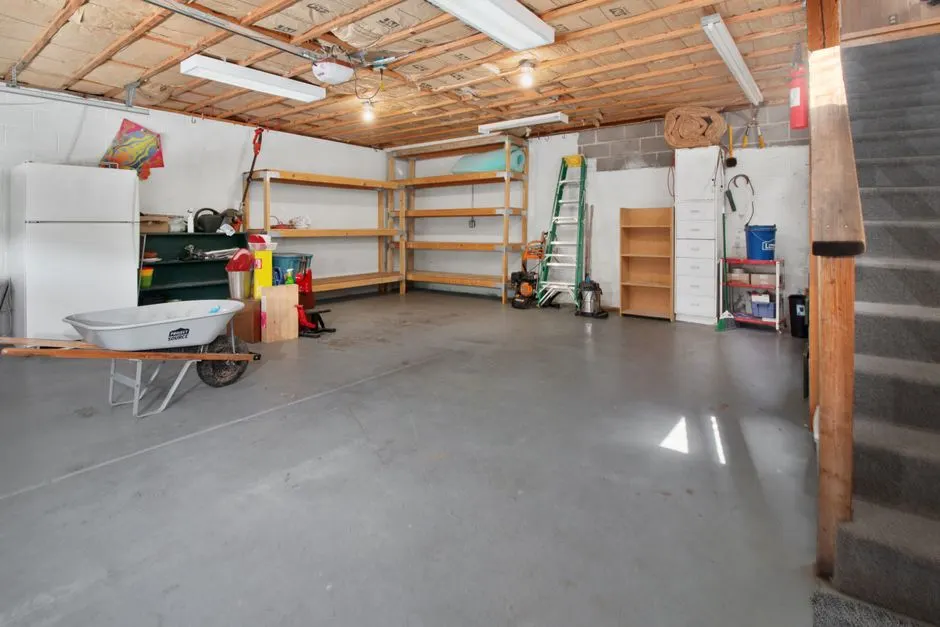
The best epoxy flooring option for a Richmond basement is a moisture-tolerant system - a 100% solids epoxy base with a polyaspartic or urethane topcoat - installed over concrete that has been ground, crack-repaired, and tested for vapour transmission first. Flake and quartz broadcast systems handle Richmond's damp, low-lying ground better than thin water-based kits, and they cost roughly $4.50 to $9.50 per square foot installed in 2026.
Richmond is built on river delta soil, and that single fact shapes every basement flooring decision here. Below, we break down which epoxy systems actually survive a Richmond winter, what they cost, and where DIY kits go wrong.
Why Richmond basements are harder on flooring than most
Richmond basements sit on silt and sand left behind by the Fraser River, with the water table often within a metre or two of the slab. That means moisture doesn't just come from rain - it wicks upward through the concrete year-round.
Add the coastal climate: roughly 1,100 mm of rain a year, humidity that sits above 70% for months, and winter temperatures that hover around 2°C to 7°C. Concrete slabs stay cool, so warm humid air condenses on them the same way a cold drink sweats in July.
Any coating that can't handle that vapour pressure will blister, peel, or turn milky within a season or two. This is why the cheap roll-on epoxy kits from big-box stores fail so often in Richmond - they're formulated for dry inland slabs, not delta ground.
If you've already got a failing coating, epoxy floor removal Richmond is usually the first step before anything new goes down.
What is the best epoxy flooring for a Richmond basement?
Basement epoxy flooring is a resin-based coating system that bonds directly to prepared concrete, sealing the slab against moisture while giving you a hard, cleanable surface. For Richmond specifically, the best build is a 100% solids epoxy base at 8-12 mils, a decorative or functional broadcast layer, and a polyaspartic or aliphatic urethane topcoat.
That three-part stack matters. The epoxy base does the bonding and moisture blocking. The broadcast layer (flake, quartz, or metallic pigment) adds texture and hides slab imperfections. The topcoat takes the wear and gives you UV stability - plain epoxy yellows under light, topcoats don't.
We install this exact system across the city, and you can see the full range of what we do on our Epoxy Flooring in Richmond, British Columbia (BC) page. For basements specifically, the finish choice usually comes down to how the room gets used.
The main epoxy options, compared
Six systems cover almost every Richmond basement we walk into. Here's how they line up.
Flake epoxy flooring
Vinyl colour flakes broadcast into a wet epoxy base, then sealed with a clear topcoat. The flake layer hides hairline cracks, trowel marks, and the patchy look of an old slab better than any other finish. It's also the most forgiving on a floor that isn't perfectly flat.
Best for: rec rooms, home gyms, laundry areas, and basements that get heavy foot traffic. Flake Epoxy Flooring in Richmond, British Columbia (BC) is our most-requested basement finish, and it's the one we'd pick for a family basement on a mid-range budget.
Metallic epoxy flooring
Pigment is mixed into the epoxy and manipulated to create swirls and depth that look like polished stone or moving water. No two pours are identical. It's a statement floor.
Best for: finished basements, home bars, media rooms, and anywhere you want the floor to be a feature. Metallic Epoxy Flooring in Richmond, British Columbia (BC) costs more than flake because it's slower to install and less forgiving of installer error, but the result is genuinely one of a kind.
Quartz epoxy flooring
Coloured quartz aggregate broadcast into the base coat. It's denser and more textured than flake, which makes it slip-resistant even when wet.
Best for: basement bathrooms, laundry rooms, and any space with a floor drain. Quartz also stands up to chemical spills better than flake.
Solid colour epoxy flooring
A single uniform colour with no broadcast. Clean, modern, and the cheapest per square foot of the decorative options.
Best for: utility rooms, storage areas, and basements where you want a simple, seamless look. The trade-off is that solid colour shows every scuff and dust speck, so it needs more frequent cleaning.
Anti-slip epoxy flooring
A standard epoxy system with an aggregate added to the topcoat for grip. In a basement, this matters more than people expect - concrete sweats in spring, and a glossy floor plus condensation equals a fall risk.
Best for: basement stairs, laundry areas, and any basement with a sump pit or floor drain. Anti-Slip Epoxy Flooring in Richmond, British Columbia (BC) is what we recommend whenever the basement sees moisture on the floor regularly.
Clear epoxy topcoat over an existing slab
A clear sealer coat over prepared concrete, with no colour layer. It locks down dust, makes sweeping and mopping easier, and lets the concrete show through.
Best for: basements where the slab itself is in good shape and you just want protection. It's the lowest-cost option, but it won't hide cracks or stains.
What does basement epoxy flooring cost in Richmond in 2026?
Typical 2026 pricing for a professionally installed basement epoxy floor in Richmond runs $4.50 to $9.50 per square foot, depending on the system, the slab condition, and how much prep is needed.
- Solid colour epoxy: $4.50-$6.00/sq ft
- Flake epoxy: $5.50-$7.50/sq ft
- Quartz epoxy: $6.50-$8.50/sq ft
- Metallic epoxy: $7.50-$9.50/sq ft
- Clear topcoat only: $3.50-$5.00/sq ft
A typical 600 sq ft Richmond basement rec room lands between $3,300 and $5,700 for a flake system with full prep. Add $800 to $2,000 if the slab needs crack repair, grinding, or moisture mitigation.
Timeline: most basement projects take two to three days on site, plus 24 hours before you can walk on it and 72 hours before you move furniture back. Cooler basement temperatures in winter can stretch the cure by another day.
Moisture testing: the step that decides everything
Before any coating goes down, we test the slab for moisture vapour emission. The standard test is ASTM F1869 (calcium chloride) or ASTM F2170 (in-situ relative humidity probes).
Here's the number that matters: if vapour emission reads above 3 lbs per 1,000 sq ft per 24 hours, a standard epoxy will fail. You need a moisture-mitigating primer or a different system entirely.
In Richmond, we find elevated readings in a meaningful share of basements - especially in Steveston, Gilmore, and older neighbourhoods near the north arm of the Fraser where the water table is highest. If your basement has ever had a damp smell, a white powdery bloom on the concrete, or efflorescence around the base of the walls, assume you'll need mitigation until testing says otherwise.
This is also why we don't quote a basement floor over the phone. The slab decides the price, and the slab has to be tested.
Common mistakes we see in Richmond basement projects
Most basement epoxy failures we're called to fix trace back to one of five things.
- Skipping moisture testing. The single biggest cause of blistering and peeling. A $150 test saves a $4,000 floor.
- Acid etching instead of grinding. Acid etch doesn't open the concrete pores the way diamond grinding does. On a Richmond slab, that means poor adhesion and eventual delamination.
- Applying over a damp slab. Concrete needs to be dry to the touch and below the moisture threshold. If your basement flooded last spring, the slab may still be holding water.
- Using a water-based big-box kit. These are 40-50% solids at best. They're thin, they don't block vapour, and they wear through in high-traffic areas within a year or two.
- No topcoat. Epoxy alone ambers under UV and scratches easily. A polyaspartic or urethane topcoat roughly doubles the service life.
We also see a lot of basements where the previous owner painted the floor with concrete paint. That has to come off completely - epoxy won't bond to paint, and it will peel in sheets.
When to call a professional
If your basement slab has visible cracks wider than a credit card, a history of water intrusion, or any sign of efflorescence, the prep work alone is beyond what a DIY kit can handle. The same goes for basements over 400 sq ft - mixing and applying epoxy fast enough to maintain a wet edge across a large floor is a two-person job with commercial equipment.
We handle the whole sequence: moisture testing, grinding, crack repair, base coat, broadcast, and topcoat. If you want a straight answer on whether your slab is a candidate, our team can walk you through it before you spend a dollar on materials. For basements specifically, we install Basement Epoxy Flooring in Richmond, British Columbia (BC) as a complete system rather than a coating over whatever's already there.
Frequently Asked Questions
How long does epoxy flooring last in a Richmond basement?
A properly installed epoxy system with a polyaspartic topcoat lasts 10 to 15 years in a residential basement. Thin DIY kits typically fail in 1 to 3 years in Richmond because they can't handle the slab moisture. Prep quality and moisture mitigation matter more than the brand of epoxy.
Can I put epoxy over a basement floor that has flooded?
Yes, but only after the slab has fully dried and passed a moisture test - usually 4 to 8 weeks after a flood, sometimes longer. If vapour emission is still above 3 lbs/1,000 sq ft/24 hrs, we apply a moisture-mitigating primer first. Coating a wet slab guarantees failure.
Is epoxy flooring slippery when wet?
Standard epoxy is slippery when wet. We add a slip-resistant aggregate to the topcoat for basements with floor drains, laundry areas, or stairs. That brings the wet coefficient of friction up to a safe range without making the floor hard to clean.
How soon can I use my basement after epoxy is installed?
Light foot traffic after 24 hours, furniture and normal use after 72 hours. Full chemical cure takes 7 days. In winter, when basement temperatures sit around 15°C, add another day to each stage. We give you a written schedule before we start.
Do I need a moisture barrier under the epoxy?
Not a sheet barrier - a moisture-mitigating primer, applied directly to the prepared slab. It's a two-part epoxy primer that blocks vapour transmission. We only specify it when testing shows the slab needs it, which is common in low-lying Richmond neighbourhoods.
Get help with Epoxy Flooring in Richmond
Richmond basements need a floor system built for delta ground, not a generic kit from a hardware store. We test the slab, prep it properly, and install a coating that will still be there in a decade.
Call Richmond Elite Epoxy Flooring at +7742316666 to book a basement assessment and get a written quote based on your actual slab.